The sea is very good at keeping secrets
Remarkably Bright CreaturesThe sea is very good at keeping secrets is an expression that gives the ocean two roles at once: it hides evidence in its depths, and it holds memories that people on shore cannot fully reach. Spoken from the perspective of Marcellus McSquiddles, it gathers the novel’s submerged relics and its human failures of communication into a single image. The sea’s secrecy is not absolute, however. What it conceals may surface later, altered but still capable of changing what the living understand.
Meaning and First Use
The expression follows a reflection on loneliness and the difficulty of sharing secrets. Marcellus observes that humans have many words but often fail to tell one another what they want; the sea, by contrast, keeps what has been lost beyond easy access. The line moves from a complaint about human silence to a fact of the physical world, making concealment more than a metaphor: the ocean can literally hold objects and remains beyond the reach of those who mourn them.
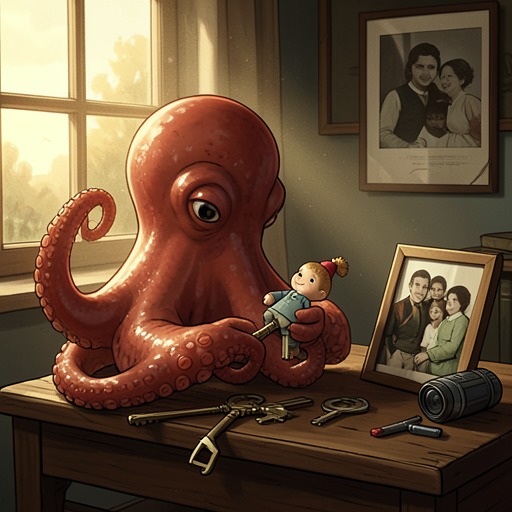
Marcellus then narrows the thought to one particular secret he carries from the seafloor. The withheld knowledge is not an abstract mystery but a cache of human remnants, preserved beneath rocks: a rubber sneaker sole, a vinyl shoelace, buttons, and a copied key. The expression gains its emotional force from the difference between knowing and being able to tell. Marcellus understands that the objects belong to the person Tova Sullivan mourns, yet the sea’s depth and his own captivity have kept that knowledge from her.
The Key and the Delayed Return of Evidence
When Marcellus encounters a key like the one he remembers from the seabed, its significance becomes clear only later. As a juvenile, before his capture, he had found a matching key attached to a circular ring among the remnants. He recognizes the connection and returns the key to Tova, calling this the least he can do for her loss. His regret that he cannot also give her the other objects makes the sea’s secrecy concrete: the clues exist, but they remain inaccessible.
This episode makes the phrase a principle of delayed disclosure. The ocean has preserved material evidence without making its meaning available to the people it concerns. Marcellus can recover one small piece, but the larger cache remains beyond his reach. Secrecy here is neither deliberate deception nor a puzzle solved all at once; it is the consequence of distance, time, and the limits imposed by captivity.
Shoreline Memory and Human Silence
The expression also resonates with Tova’s own relationship to the water. At the pier, she watches moonlight move across the surface and imagines Erik Sullivan beneath it, holding candles for her. The sea gives form to a grief that cannot be resolved by what is visible from shore: its surface reflects light, while the depth below holds what she cannot see or know.
On land, remembered details can emerge through conversation. Tova and Ethan Mack recall Will Sullivan’s habit of taking pens from restaurants and counters; Ethan remembers Will visiting the deli for a sandwich and a book, and Tova responds warmly. Such memories are available because people can exchange them. The underwater cache is different: its contents have survived, but human communication cannot bridge the distance until Marcellus’s recognition brings one object back.
Return to the Depths
The phrase acquires a final, intimate resonance when Tova takes the gravely weakened Marcellus from the waterfront toward the jetty in a yellow bucket. At the low tide, moonlight falls across shallow pools on the exposed beach. After Tova releases him, Marcellus swims beyond the rocks and descends into the dark depths where he had found the key as a juvenile. He returns to lie with the long-disintegrated bones of a beloved son, and the sea that once concealed the relics becomes his chosen home again.
The expression therefore joins concealment to both loss and return. The ocean keeps the past out of sight, but it also preserves the traces through which the past can be recognized. Its secrets are not all revealed, and the text does not make the sea a simple archive that gives everything back. Instead, the key’s return and Marcellus’s final descent hold together what can be recovered and what remains below: a limited act of disclosure set against a depth that still keeps its own counsel.